Showing posts with label television. Show all posts

Saturday, November 21, 2015

SFC

Brawny.  Beastly.  Brave.  Powerful.  Demanding.  Vigorous.  Competent.  Robust.  Fierce. Determined.  Aggressive.  Authoritative.  Forceful.  Triumphant.


Do any of the above words describe your favorite female character?  Maybe all of them?  What if none of the words describe her?  Is she still strong?

Readers, viewers and gamers - especially females - are almost assaulted with the phrase "strong female lead" (SFL).  It's even a Netflix category, at least in my account: "Period Dramas with a Strong Female Lead" or something like that.  Directors, producers and screenwriters are raked over the coals if their works don't feature enough "strong female leads".  People everywhere have "rediscovered" the Bechdel test and are applying it not only to new films but old favorites.  If you've never heard of this test, read the comic below.  It was originally written by an America cartoonist Allison Bechdel, waaaaaay back in 1985:

Image from wikipedia.org.

SFC #1: Diplomatic, intelligent, passionate,
self-sacrificial, determined.  Can handle firearms.
Image from starwars.com.
The thing is, a movie can still be "good" without passing the test.  It can even have an SFC without passing the test.  Two of my all-time favorite trilogies, the original "Star Wars" series and "Lord of the Rings", actually fail this test. However, they contain some of the most amazing, powerful, BA female characters in the realm of sci-fi/fantasy: Princess Leia, Arwen, Galadriel, and Eowyn.  I'd be hard-pressed to find someone who didn't consider these ladies strong characters.

But - wait a minute.
SCL #2: Wise, commanding, compassionate, noble.
 Likes coffee.  A lot.
Image from fanpop.com
What makes a character - in particular a female character - strong?  I mentioned this in my last post, specifically in regards to some of the characters in Once Upon a Time, but I didn't really explore it a lot.  I mean, who defines strength?  The words I used to open this post are all considered synonyms of "strong", but I don't know if they are all necessary for an SFC.  What makes an SFC?  What qualities does she have?  What qualities would make a female character weak?  Does it depend on her environment, the setting of the movie or book?  I don't think a lot of people would consider the lead characters in movies from the 30s, 40s, and 50s to be "modern" SFCs.  Maybe Scarlett O'Hara.  Maybe Cleopatra.  Maybe Gilda.  Are these women SFCs in our time period, or during their own, or not at all?  Can a woman who just wants to be loved be considered an SFC?  Could a stay-at-home-mom or chicken-roasting housewife be an SFC?  Why or why not?

SFC#3: Fierce, loyal, brave, devoted,
skilled.  Unlucky in love (at first.)
 Image from lotr.wikia.com.
We lay the contemporary definition of feminism on so thick when we adapt fairy tales and historical fiction and non-fiction that I think it's hard for us to see a lot of female leads from the past as "strong" by today's standards.  If they're not speaking up for themselves, or smashing the patriarchy, then they're meek and weak and awful role models.  Yes, that's a generalization, but let's see...everyone knows the Lizzie Bennett is the heroine of Pride and Prejudice, right?  She thinks for herself and expresses her own opinion and still ends up with the right guy in the end.  Swoon.  Her older sister, Jane, is gentle and soft-spoken, long-suffering and forgiving.  She struggles with the loss of her beloved, but chooses to carry on with her life.  Is she weak?  We would probably consider her to be, yes, because she doesn't actively fight for what she wants.  But when we remember the society in which she lives, we need to view her differently.  She truly wants to make her parents happy, and knows that all four of her not-always-obedient sisters have the potential to break her parents' hearts, embarrass the family, and bring lasting shame on their name.  To choose your family's reputation over your own happiness seems ludicrous to us today, but when her family's future was on the line, Jane was willing to quietly wade through sadness and disappointment in order to spare them embarrassment or worse.  Self-sacrifice can be a sign of strength.  We see Lizzie as strong, but some of that strength came from a selfish, proud place.  She didn't think twice about embarrassing other people, as long as she had the chance to speak her mind (we see Austen's Emma Woodhouse struggling with the same attitude).  

SFC #4: Confident, talented, devoted,
 loving.  Retains sense of humor despite danger.
 Image from comicrelated.com
Jessica Jones is the latest SFC to burst onto the Marvel/Netflix scene.  As her story unfurls, we learn that she is physically extremely strong - "gifted" - but deeply emotionally damaged due to severe sexual and mental abuse.  She has been diagnosed with PTSD and self-medicates with alcohol.  In my opinion, it would be more a show of strength to ask for help rather than to shut one's friends out of one's life - so I don't see her, at least early on - the same way I see Princess Leia, who, when we meet her, has already made sacrifice after sacrifice for the cause of peace, having found something to believe in.  Apples and oranges, maybe, but it's something to consider.  What kind of strong is the SFC?  Does she grow in strength as her story is told?  Does her kind of strength change?
  
I haven't watched Scandal, but from what I've read and heard about Olivia Pope, it's unlikely
SFC #5: Powerful, fearless, gifted, courageous.  Actually capable of
physically smashing the patriarchy.  Image from wordandfilm.com.
that I personally would admire her. From what I gather, she's dangerously manipulative, influential, and selfish.  (Please, fans of the show, correct me if I'm wrong!) I can't deny that she is a strong character, but it's interesting that "strong" doesn't necessarily mean "likable", "virtuous", or even "at least vaguely morally upright". 

It looks like I'm uncovering more questions than I have answers.  What do you think?  What makes a female character "strong"? How does her femininity, her sexuality, or anything else play into it?  Who are the SFCs that you admire?  Are there female characters you admire that you would not consider "strong"?  Why do you admire them?  If you can compare them to male characters with similar paths or personalities, what do you see?  How much of the SFC's environment contributes to your perception of her strength?

Does this feel like a Literary Analysis essay test yet?

Yes?  Then my work here is done.  Think on these things, friends.

Monday, December 22, 2014

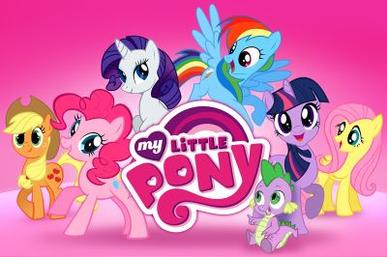
My Little Brony

There is a chance I am accidentally-on-purpose raising my infant son to be a fan of My Little Pony.  Is it because I'm a raging feminist, hell-bent on smashing gender-norms?  Is it because I can't stand cartoons for little boys?  Is it because I am obsessed with pink and sparkly things?

No on all counts.

Except the pink and sparkly one.  I do like things that are pink and sparkly.

I guess, even before I get started, I should explain that I am NOT plopping my baby down in front of the television and walking away for hours on end.  We watch a little bit, though, mostly because it helps with his torticollis (he is supposed to do stretching and exercises to strengthen the neck muscles on his left side).  If I position him a certain way, and he is interested in something (be it the TV, the cats, or a toy), he'll force his head to turn in the correct direction.  So there, that's for all the parents out there who are scandalized that I would even begin to allow my baby to become part of the entertainment culture.

Moving on...

I am an adult, yes, and I like cartoons.  I always have.  But even I approached the latest incarnation of My Little Pony with hesitation.  I'd heard about bronies and I thought that whole thing was a little weird.  I was a fan of the franchise when I was a child, but it wasn't my favorite.  (That honor would have been a tie between Jem and the Teenage Mutant Ninja Turtles, with She-Ra and the Ghostbusters following close behind.)  But, as I stated above, I like sparkly things, and I really enjoy Flash animation.  

So I got hooked.

Image from en.wikipedia.org.
It was easy to identify with Twilight Sparkle.  She's initially an introvert, a reader and scholar who prefers not to interact with people.  Hi, that's me kind of.  She's also a perfectionist and has a lot of potential.  Also kind of me-ish.  As the series progressed, I found my friends represented in the other main characters.  My friend Jaime, who I frequently mention on this blog, is like Pinkie Pie in that she is exceptionally outgoing, loves making people smile, and has boundless energy (even though she has FOUR rambunctious daughters).  My friend Emily has an element of Rarity to her; though I wouldn't call her vapid or vain, she's intensely creative, talented, and has a definite eye for design and fashion.  My friend Lindsay isn't as bashful as Fluttershy, but she is gentle, kind, sweet, soft-spoken and full of love for living things.  My sister Jules is the epitome of Applejack - a green-eyed, blond-haired country girl who doesn't mind getting dirty and who has the work ethic of, well, a Clydesdale.  My friend Jordan is a tough rebel-turned-good girl who is confident and strong-willed, but who would do anything for her friends.  I think that makes her Rainbow Dash.

Having said all that, why is it so important for my son to watch this show as he grows up?  Well...as much as I love the superhero cartoons, they don't talk a whole lot about second chances and redemption.  The thing I love most about MLP: Friendship is Magic is the element of forgiveness.  I love the way that the characters grow and learn, and their progress isn't erased as new storylines develop.  I love that, in multiple story arcs, the "bad guys" are given the chance to be heroes, to learn from their mistakes, and to make friends.  Sometimes they change, and sometimes they don't, but it's rare to see that kind of progressiveness in cartoons.  Regardless of the medium, what a beautiful lesson to teach children!  That we make bad choices and it's okay to try again.  That a friend's bad choices doesn't mean she is a bad person. That people can change when they want - or need - to.  That trust must be earned and valued.

And, that it's okay for that lesson to be wrapped up in a sparkly pink bow.

Even for boys.

Wednesday, October 17, 2012

A Dream Is A Wish...

I admit, I have been trying not to get sucked into total couch potato-dom during this season of unemployment.  I'm trying to write, to get out of the house, to clean (ha, ha!), to lose some weight (only 1200 calories a day?  Are you KIDDING?) to spend some time with family...
 
...but, you know, things happen.  I ended up watching the entire first season of Once Upon a Time in about three days.  I even had Ross watching with me near the end, after I carefully laid out the plot for him.  (I guess I did an okay job; he followed pretty well.)
 
I have always loved to see fairy tales reworked - I like the idea of exploring the "after happily ever after" as much as I love the  simple joy of the happy endings themselves.  So many of the stories that we hold dear - Cinderella, Snow White, Beauty and the Beast - are only a few of many, many versions that have been handed down through centuries of retellings, both written and oral.  As a storyteller myself, secretly love the idea that, perhaps, one night, while a particular proto-feminist bard was regaling his listeners with the tale of Little Red Riding Hood, he decides that it wasn't the Huntsman who killed the wolf, but a brave Red herself!  Perhaps a mother telling the story of Cinderella to her children and remembering her own abusive childhood, added the characters of the two wicked stepsisters as a final act of judgment on her own family.  Therefore, I have really enjoyed the modern twist on fairy tales that the ABC series is producing.
 
I was brushing my teeth the other day and I got to thinking about the plot - a young boy is the only believer in an ancient curse that affects his entire town - and it really hit home.  Because he's right.
 
It's all true.
 
Why have these sorts of stories captured our imaginations for hundreds of years?  Why do our hearts break when love seems forever lost?  Why do we rage when the villain - the witch, the demon, the troll - deceives the hero?  Why do our spirits soar when the prince victoriously kills the dragon?

Because the story being told is our story.

We are the helpless, trapped children of the King - all of us.  We have been tricked by the wicked, bloodthirsty enemy who has disguised himself as something utterly harmless.  Our rights and privileges and inheritance have been stolen from us through deceit.  Love and hope are lost to us - but for the King's Son, who has come to save us.  His presence forces the enemy to reveal his true form - and the battle begins.  Blood is spilt, and a price is paid.  Our freedom is won through sacrifice.  We are reinstated as princes and princesses, and our Father the King forgives us for trusting the one who would destroy us. 

All art is inspired, whether by God, man, or the devil.  I truly think that God inspired the threads of these stories as they were woven into and through countless cultures and languages with but one theme: good will win.  The enemy will be found out and destroyed, and the prince will reign triumphant over his beloved kingdom.

Happily ever after.  Forever.